
For years, B2B marketers treated search like a pipeline.
A prospect searched on Google, landed on a website, downloaded a whitepaper, booked a demo, and entered the sales funnel. The journey was relatively linear, measurable, and heavily dependent on SEO rankings.
That model is now breaking apart.
Not because Google disappeared. But because discovery is fragmented.
Today, a B2B buyer might first encounter your brand:
- through a founder’s LinkedIn post,
- a YouTube implementation breakdown,
- a Reddit discussion comparing vendors,
- or an AI-generated recommendation before they ever visit your website.
Most marketers already know this at a surface level. The more important question is:
What changes strategically when search is no longer centralized?
Because this shift isn’t just changing where buyers discover brands.
It’s changing:
- how trust gets built,
- how authority gets measured,
- and what kind of content actually influences decisions.
And that’s where most B2B marketing strategies are falling behind.
The Real Shift Isn’t Social Search. It’s Distributed Trust.
The biggest misconception in B2B marketing right now is that social search is simply “SEO on more platforms.”
It’s not.
Traditional SEO rewarded discoverability.
Modern discovery rewards the accumulation of trust across ecosystems.
That distinction matters.
A buyer no longer evaluates your company based on a single website session. They build perception through repeated micro-interactions across platforms:
- a smart LinkedIn insight,
- a helpful YouTube walkthrough,
- a Reddit mention,
- an AI-generated summary,
- a founder interview,
- a podcast clip,
- a comment section discussion.
Individually, these touchpoints may seem small.
Collectively, they become a credibility infrastructure.
That’s why many brands with mediocre websites are still outperforming stronger competitors in visibility and lead generation. Their authority exists outside their website.
In B2B marketing today, your brand is no longer what your website says about you.
It’s what the internet consistently says about you.
Why Traditional SEO Thinking Is Quietly Becoming Inefficient
Many B2B companies are still investing heavily in:
- keyword-heavy blog calendars,
- gated PDFs nobody reads,
- SEO articles are written for algorithms instead of buyers,
- and traffic metrics are disconnected from buying intent.
The issue isn’t that SEO stopped working.
The issue is that search behavior changed faster than most SEO strategies could keep pace.
A Google search used to signal active discovery.
Now, buyers often arrive at Google after they’ve already formed opinions elsewhere.
That means Google is increasingly becoming:
- a validation platform,
not always - a discovery platform.
This changes the role of content dramatically.
Your content can no longer exist only to rank.
It now needs to:
- build familiarity,
- reinforce authority,
- travel across platforms,
- and survive AI summarization.
Because AI tools don’t evaluate your brand the way search engines used to.
They synthesize reputation.

Why YouTube Is Becoming More Influential Than Most B2B Blogs
One of the clearest examples of this shift is YouTube.
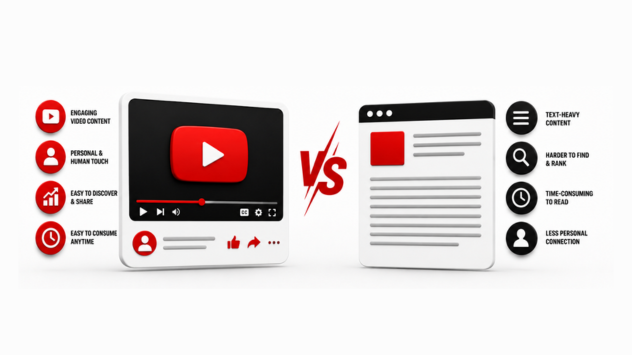
Most B2B companies still treat YouTube as a secondary awareness channel. In reality, it’s becoming one of the strongest mid-funnel trust platforms in digital marketing.
Why?
Because complex decisions require confidence.
And confidence is built faster through:
- demonstrations,
- explanations,
- implementation visibility,
- and human communication.
A prospect reading a 1,500-word SEO blog about your software may still hesitate.
But watching:
- a product teardown,
- a workflow breakdown,
- a founder explaining strategy,
- or a real implementation example
creates a level of trust that static content struggles to match.
This is especially true in high-consideration B2B industries where buyers want to reduce risk before committing.
Today’s B2B buyer often watches before they visit.
And that has major implications for content strategy.
The Rise of “Search Everywhere Optimization”, And What Most Brands Get Wrong About It
Many marketers hear “multi-platform discovery” and respond by trying to be everywhere at once.
That usually fails.
Because visibility is not about platform presence alone. It’s about strategic consistency.
The real opportunity is not publishing identical content across every platform.
It’s building a connected discovery ecosystem.
For example:
- LinkedIn builds authority,
- YouTube builds trust,
- SEO captures intent,
- AI visibility reinforces credibility,
- And community discussions validate reputation.
Each platform serves a different psychological role in the buyer journey.
Most brands fail because they treat every platform as a distribution channel instead of a trust layer.
That leads to:
- disconnected messaging,
- inconsistent positioning,
- generic content,
- and low recall.
The brands succeeding right now are doing something very different.
They are creating:
- narrative consistency,
- recognizable expertise,
- platform-native content,
- and repeated authority signals.
In other words:
They are optimizing for memory, not just impressions.
What Most B2B Marketing Strategies Still Ignore
The uncomfortable reality is this:
A large percentage of B2B content today exists purely because “marketing teams need content.”
Not because buyers need it.
That’s why the internet is flooded with:
- AI-generated blogs,
- recycled LinkedIn advice,
- empty thought leadership,
- and SEO content with no actual perspective.
And buyers can feel that instantly.
The next phase of B2B marketing will reward:
- clarity over volume,
- expertise in optimization,
- and a recognizable perspective on generic consistency.
Because when every brand has access to AI tools, production stops being an advantage.
Interpretation becomes the advantage.
The brands that will outperform in this environment are the ones that:
- explain better,
- teach better,
- communicate more clearly,
- and develop a stronger market perspective.
Not necessarily the ones publishing the most.
So What Should Brands Actually Do Differently?
The strategic shift is simpler than most marketers think.
Instead of asking:
“How do we rank higher?”
Modern B2B teams should ask:
“Where does trust actually get built before conversion?”
That changes everything.
It changes:
- content formats,
- distribution strategy,
- founder visibility,
- platform investment,
- and even how success gets measured.
Because visibility today is no longer just about traffic acquisition.
It’s about authority accumulation.
A Final Thought
At 361 Degrees Marketing, we believe the future of B2B marketing belongs to brands that understand discovery is no longer linear.
Search has evolved from a ranking game into a trust ecosystem.
And the brands that will lead the next era of digital growth won’t necessarily be the loudest or the most optimized.
They’ll be the ones buyers encounter consistently, trust instinctively, and remember long before a sales conversation begins.