

A year ago, brands were asking whether they should use AI for content creation.
Today, the question is different: “How can we use AI without making our content sound like everyone else’s?”
Everyone is using it.
From social media captions and blog posts to email campaigns and product descriptions, AI has become one of the most widely adopted tools in modern marketing. It promises speed, efficiency, and the ability to create content at scale.
And for a while, that sounded like the perfect solution.
But as more businesses rush to publish AI-generated content, a new problem is emerging.
Everything is starting to sound the same.
The same phrases. The same structures. The same predictable insights.
In a digital landscape where attention is harder to earn than ever, blending in is becoming one of the biggest risks a brand can face.
The issue isn’t AI itself. The issue is Generic AI content.
And for many brands, it’s quietly weakening the very thing marketing is supposed to build: differentiation.
Why Generic AI Content Is Everywhere
The rise of Generic AI content isn’t surprising.
AI tools are designed to identify patterns, analyze existing information, and generate responses based on what already exists online. That makes them incredibly effective at producing content quickly.
The challenge is that speed often comes at the expense of originality.
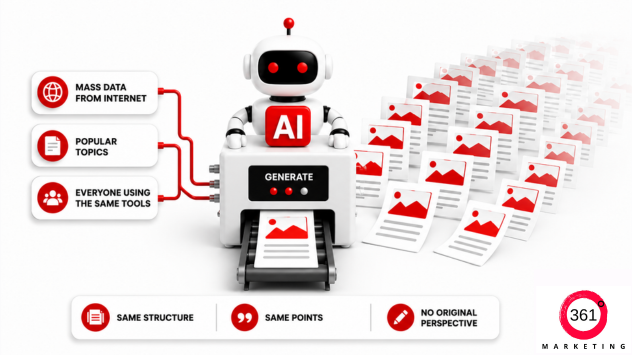
When thousands of brands use similar prompts, rely on the same tools, and publish content based on the same datasets, the result is a flood of content that feels familiar before it’s even finished loading.
The irony is that brands adopt AI to stand out faster, but many end up sounding more alike than ever.
In industries where differentiation matters, Generic AI content can create a sea of sameness that makes it difficult for customers to remember who said what.
And if your audience can’t remember your brand, they probably won’t choose it.
How Generic AI Content Is Weakening Brand Identity
Every successful brand has a distinct voice.
Some are bold.
Some are playful.
Some are authoritative.
Some are conversational.
That voice is often built over years of customer interactions, campaigns, and storytelling.
Generic AI content tends to flatten those differences.
Because AI naturally gravitates toward statistically common language, it often removes the quirks, perspectives, and personality traits that make brands memorable.
As a result, businesses start publishing content that may be grammatically correct and factually accurate but lacks character.
Customers don’t build emotional connections with perfectly structured paragraphs.
They connect with ideas, opinions, stories, and experiences.
The more a brand relies on Generic AI content without adding its own perspective, the more its identity begins to fade into the background.
And in crowded markets, being forgettable is often more dangerous than being wrong.
Why Generic AI Content Creates Trust Problems
Modern consumers are becoming surprisingly good at spotting AI-generated content.
They may not always know exactly why a piece feels artificial, but they can sense when something lacks authenticity.
The language often feels overly polished.
The insights feel recycled.
The advice sounds familiar.
Over time, this creates a subtle trust issue.
People trust expertise.
They trust experience.
They trust unique perspectives.
But Generic AI content often presents information without demonstrating genuine understanding.
The result is content that informs but rarely convinces.
For brands trying to establish authority, this can become a significant challenge.
Customers don’t just want answers anymore.
They want evidence that the brand behind those answers understands their problems.
That level of trust cannot be automated entirely.
It still requires human insight, creativity, and strategic thinking.
Why Generic AI Content Is Becoming Less Effective for SEO
For a while, many businesses believed AI would make content marketing easier.
Generate more articles.
Publish more frequently.
Rank faster.
But search engines are evolving alongside AI.
Today, search visibility depends less on content volume and more on content value.
Search platforms increasingly prioritize expertise, originality, usefulness, and user experience.
That’s where Generic AI content struggles.
If your article says exactly what hundreds of other articles have already said, there’s very little reason for search engines or users to prioritize it.
The brands winning organic visibility today aren’t necessarily producing more content.
They’re producing better content.
Content that offers fresh perspectives.
Content that demonstrates real-world expertise.
Content that contributes something meaningful to the conversation.
AI can support that process, but it cannot replace the strategic thinking that makes content worth reading.
How Brands Can Use AI Without Creating Generic AI Content
The solution isn’t abandoning AI.
Far from it.
AI remains one of the most valuable tools available to marketers today.
The difference lies in how it’s used.
The strongest brands treat AI as a collaborator, not a replacement.
They use it to accelerate research.
Generate ideas.
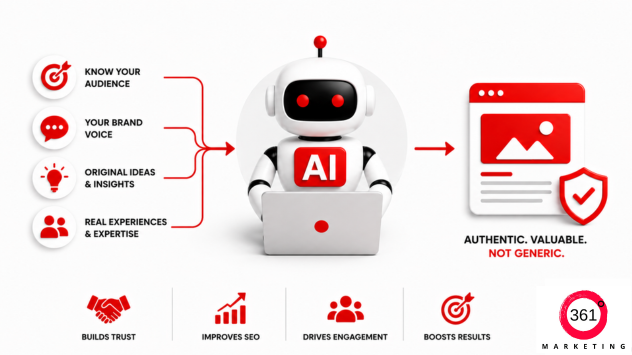
Explore content structures.
Improve efficiency.
But the final layer always comes from humans.
They add unique perspectives.
They inject brand personality.
They challenge conventional thinking.
They bring real-world experiences into the conversation.
In other words, they use AI to create faster, not to think for themselves.
When combined with strategic direction and creative expertise, AI can amplify a brand’s voice rather than dilute it.
The key is ensuring technology supports differentiation instead of replacing it.
The Future Isn’t AI Content. It’s Better Content.
AI is changing marketing, and there’s no going back.
But as more brands adopt the same tools, originality becomes even more valuable.
The businesses that thrive won’t be the ones publishing the most AI-generated content.
They’ll be the ones combining technology with human creativity, strategic thinking, and authentic storytelling.
Because customers don’t remember content simply because it exists.
They remember content that makes them think differently.
At its best, AI helps brands work smarter.
At its worst, Generic AI content turns unique businesses into interchangeable voices competing for the same attention.
The opportunity isn’t to create more content.
It’s to create more meaningful content.
That’s why forward-thinking marketing teams are focusing less on automation alone and more on building content strategies that balance innovation with authenticity. The most effective brands understand that technology may accelerate the process, but differentiation still comes from insight, creativity, and a deep understanding of the audience.
At 361 Degrees Marketing, we’ve seen that the brands achieving the strongest results with AI aren’t the ones relying on automation to do all the work. They’re the ones using AI strategically while staying true to their unique voice, audience, and business goals. The real advantage comes from combining smart technology with even smarter storytelling.
Because in a world filled with AI-generated noise, the brands that sound human will always stand out.
Ready to Create Content That Sounds Like Your Brand, Not Everyone Else?
Discover how strategic content marketing can help your brand stand out in an AI-driven world.